When your leasing platform goes down on the first of the month, your IT model stops being a back office decision.
It becomes an operations problem.
Rent payments slow down. Leasing teams lose access to the tools they use every day. Regional managers start chasing updates. Residents get frustrated. Executives want answers. And the person responsible for fixing it may be a break-fix technician who has never seen your environment, one internal IT generalist already stretched across dozens of sites, or a managed IT partner who has been monitoring the issue before your team noticed it.
That is the practical difference between break-fix, in-house IT, and managed IT services.
For multifamily and commercial real estate operators, the right choice is not always the cheapest option on paper. It depends on your portfolio size, your geography, your risk tolerance, your compliance requirements, and how much downtime your operation can absorb.
This article breaks down break fix vs managed IT services, in-house IT vs managed services, and how to choose the IT support model that fits the way your portfolio actually runs.
The Challenges Of Choosing The Right IT Support Model For Your Property Management Firm
Property management companies do not operate like a single office with everyone under one roof.
Your teams may be spread across leasing offices, corporate headquarters, maintenance sites, regional offices, and remote work locations. Your systems touch rent collection, resident communications, accounting, access control, vendor coordination, document storage, and leasing activity.
That creates a different IT problem than a typical small business faces.
A slow laptop is annoying. A down leasing platform during peak activity can stall revenue. A missed backup is concerning. A failed recovery after a ransomware event can threaten operations. A confused help desk experience is frustrating. A support gap across thirty sites can turn into days of lost productivity.
That is why property management IT support has to be evaluated through business continuity, not just hourly rates or monthly fees.
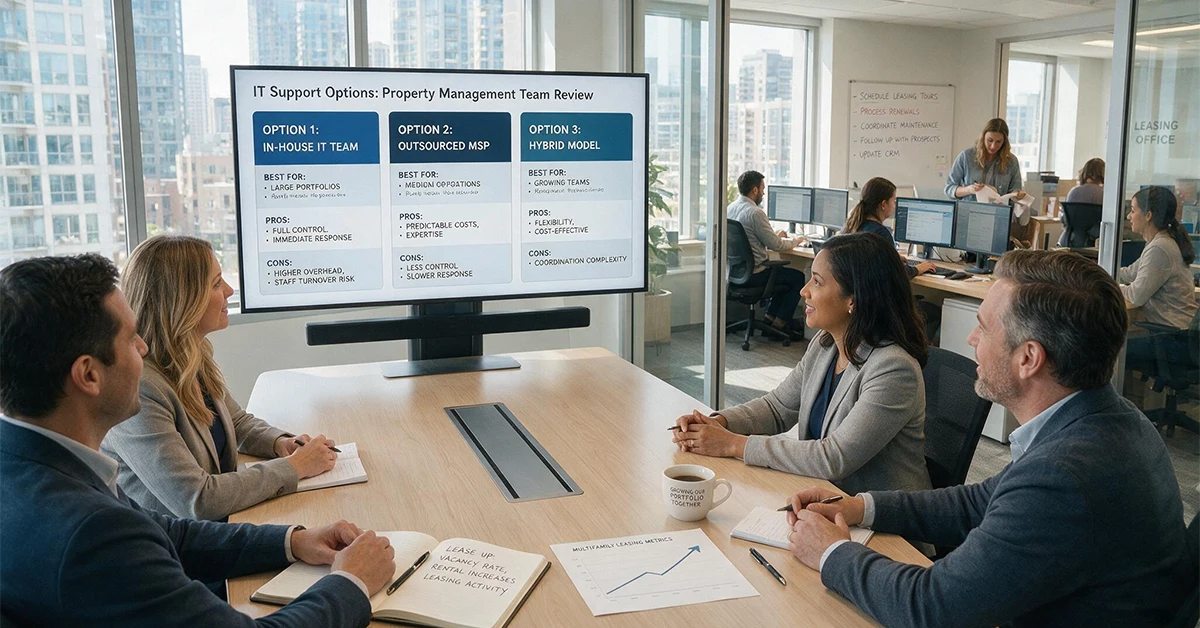
Most operators are weighing one of three models:
- Break-fix IT, where you call someone when something breaks.
- In-house IT, where you hire internal staff to own support.
- Managed IT, where an outside partner provides ongoing support, monitoring, security, backup, and strategy.
Each model can work in the right situation. Each one can also become expensive when it is forced into the wrong portfolio.
What Break-Fix IT Means for a Property Portfolio
Break-fix IT is the simplest model to understand.
Something breaks. You call a technician. They diagnose the issue. You pay for the time it takes to fix it.
For a very small operation with limited technology needs, that can be enough. If you have one office, a handful of users, basic software, and low dependency on connected systems, break-fix may feel practical. You are not paying a monthly fee. You only pay when there is a problem.
The problem is that property operations rarely stay that simple for long.
Break-fix is reactive by design. No one is watching your systems between calls. No one is proactively checking backups. No one is monitoring device health, patching issues before they become outages, or looking for patterns across recurring tickets. The provider gets involved after your staff have already felt the disruption.
NIST recommends regularly updating and patching software, backing up data, and testing backups as part of basic cybersecurity risk management.
There is also an incentive problem.
A break-fix provider gets paid when things break. More issues mean more billable hours. That does not mean every break-fix technician acts poorly. Many are skilled and honest. But the business model itself is not built around prevention.
For a property company, that matters. If a leasing office cannot access the resident portal, the outage has already started. If a remote site loses connectivity, the delay has already hit staff. Break-fix support starts after the business has absorbed the damage.
Break-fix can fit very small operators with minimal complexity. It becomes harder to justify when your systems are central to leasing, payments, resident communications, and portfolio oversight.
What in-house IT actually means across a distributed portfolio
In-house IT sounds like control.
You hire someone. They learn your systems. They support your staff. They understand your priorities. They are part of the organization, not an outside vendor.
That can be valuable, especially for larger operators with enough scale to build a real internal team.
The challenge is that many property companies do not hire a department. They hire one person.
That person becomes the help desk, network troubleshooter, device manager, cybersecurity lead, software coordinator, backup checker, vendor liaison, onboarding support, executive advisor, and emergency responder. They are expected to support headquarters, remote workers, leasing offices, regional teams, and sometimes residents or site vendors who touch connected systems.
That is a lot for one generalist.
Coverage becomes the first issue. What happens when they are on vacation? What happens after hours? What happens when three sites need help at once? What happens when the outage lands during the first of the month rush?
Expertise becomes the second issue. One person cannot be an expert in every system, security control, compliance expectation, cloud platform, backup process, and vendor relationship. Even strong IT professionals have limits.
Cost is the third issue.
An experienced IT manager can easily become a six figure salary decision before benefits, taxes, tools, training, software, and backup coverage are included. If you need more than one person, the cost rises quickly. If you only hire one person, you still have a coverage and specialization gap.
In-house IT makes sense for larger operators with enough users, locations, and internal maturity to support a true department. But for many small and mid-sized property management companies, one internal person becomes the bottleneck instead of the answer.
What managed IT means for a property management company
Managed IT services shift the model from reactive support to ongoing responsibility.
Instead of waiting for something to break, a managed service provider monitors your systems, supports users, manages devices, handles security basics, checks backups, patches software, supports cloud services, and helps leadership plan technology decisions.
For property management companies, the fit is often strong because the model is built for distributed teams.
A good managed IT partner can support users across multiple sites without requiring an on-site technician at each location. Leasing staff can contact a help desk. Corporate users can get support. Remote employees can be secured. Devices can be monitored. Backup and recovery can be reviewed. Security tools can be managed. Leadership can get guidance from someone who sees the full environment.
The incentive alignment is also different.
A managed IT provider is typically paid a predictable monthly fee. The provider wins when tickets drop, systems stay online, users need less emergency help, and the account is stable. That creates a stronger incentive to prevent issues instead of billing for every failure.
This does not mean every managed IT provider is equally proactive. Some still operate like a help desk with a monthly invoice. The difference is that the managed model, done well, is designed around prevention, standardization, security, and planning.
For a property portfolio, that can mean fewer recurring issues across sites, clearer support channels, more predictable IT spending, and better protection for the systems staff rely on every day.
For operators that already have internal IT staff but need more coverage, there is also a co-managed option. Your internal person keeps company context and day to day ownership, while a managed partner adds depth in areas like cybersecurity, backup oversight, after hours support, and strategic planning. This gives larger property companies bench strength without replacing the internal team entirely.
Break-fix vs managed IT services: the business model difference
The biggest difference between break-fix and managed IT is not the invoice format.
It is the operating philosophy.
Break-fix asks, “Who can fix this after it breaks?”
Managed IT asks, “What needs to be monitored, maintained, secured, and improved so this disruption is less likely to happen?”
That difference shows up in everyday operations.
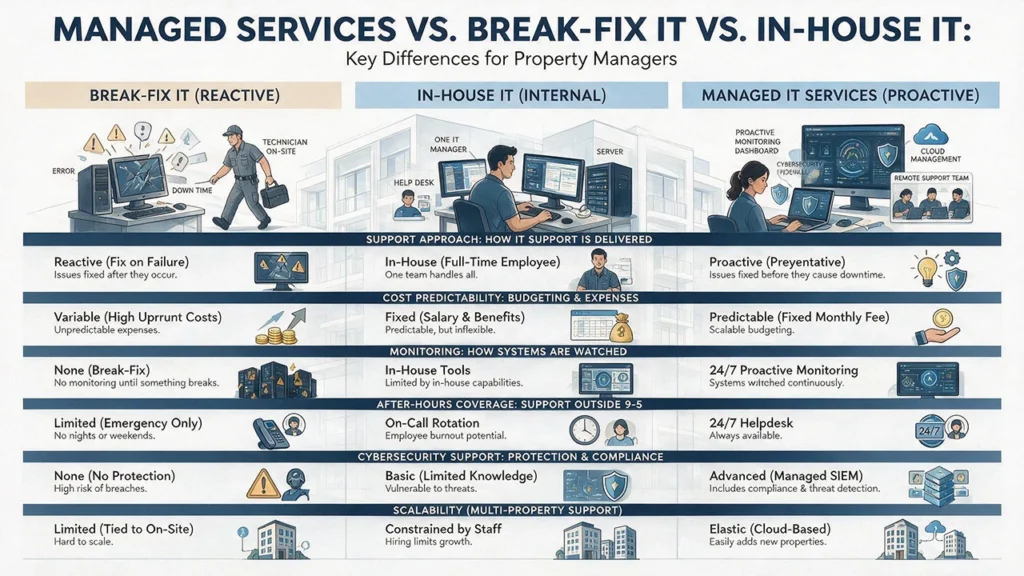
With break-fix, your team may not know there is a problem until staff report it. With managed IT, monitoring can catch some issues earlier. With break-fix, backup problems may go unnoticed until recovery is needed. With managed IT, backups should be checked and reviewed before a crisis. With break-fix, the technician may not understand your property systems or site structure. With managed IT, the provider should document the environment and support it consistently.
For a property company, the value is not just technical. It is operational.
The fewer surprises your staff face, the less time leadership spends chasing vendors, explaining the same problem repeatedly, or trying to figure out who owns the issue.
So what does each model actually cost?
Cost comparisons can get messy because the invoice does not tell the whole story.
Break-fix often looks cheapest when nothing is wrong. Managed IT can look more expensive because the monthly cost is visible. In-house IT can look straightforward because it is a salary decision. But each model carries different hidden costs.
Here is the practical comparison.
Break-fix IT
You pay hourly when something breaks. Rates vary by market, urgency, and whether support is remote or on-site. The monthly cost can be low during quiet periods, but emergency work, after hours support, travel, repeated issues, and downtime can make the total unpredictable.
Best fit: very small operators with simple systems and low technology dependency.
Main risk: you absorb the disruption before anyone starts fixing it.
In-house IT
You pay salary, benefits, tools, training, software, and sometimes outside specialists when the internal person needs help. An experienced IT manager can become a six-figure salary decision before benefits, taxes, tools, training, software, and backup coverage are included. The Bureau of Labor Statistics provides additional data on computer and information systems manager compensation. A full internal team costs more but provides better coverage.
Best fit: large operators with enough scale to support a real IT function.
Main risk: one person becomes responsible for too much, and coverage gaps remain.
Managed IT services
You typically pay a fixed monthly fee, often priced per user, device, or location. Many providers fall somewhere around $100 to $250 per user per month depending on scope, service level, cybersecurity needs, compliance requirements, and support expectations.
Best fit: small and mid-sized property companies with distributed teams, recurring support needs, security requirements, and a need for predictable IT spend.
Main risk: choosing a provider that only reacts to tickets instead of leading proactively.
For many small and mid-sized operators, managed IT can provide broader coverage for less than the cost of building an internal department. But the better question is not “which is cheapest today?” It is whether one person can realistically provide the coverage, security, backup oversight, vendor management, and strategic guidance your portfolio needs.
Often, the answer is no.
Which IT model is right for your portfolio?
There is not one answer for every property company.
If you are a very small operator with simple systems, limited risk, and low dependence on technology, break-fix may be enough for now. Just understand that you are choosing a reactive model. It may save money during quiet months, but it will not prevent the disruption before it reaches your team.
If you are a large operator with significant scale, complex systems, and enough budget to hire multiple skilled people, in-house IT may make sense. The key is making sure it is truly a team, not one person expected to cover everything.
If you are a small or mid-sized property management company with multiple sites, growing technology needs, security concerns, and a need for predictable support, managed IT is often the better fit.
If you already have internal IT but need more coverage, better security, or strategic depth, co-managed IT may be the most practical option.
The right question is not, “Which model is cheapest today?”
The better question is, “Which model gives our portfolio the support, protection, and planning we need to keep operating without preventable disruption?”
That is the question every operator eventually answers. It is better to answer it before the leasing platform goes down on the first.
Not sure which IT support model fits your portfolio?
Far Out Solutions helps property management companies build IT support models that match the way their portfolios actually operate. That includes responsive help desk support, proactive monitoring, cybersecurity, backup and recovery planning, vendor coordination, and strategic guidance for long term technology decisions.
If you are not sure whether your current model is enough, the next step is a practical conversation.