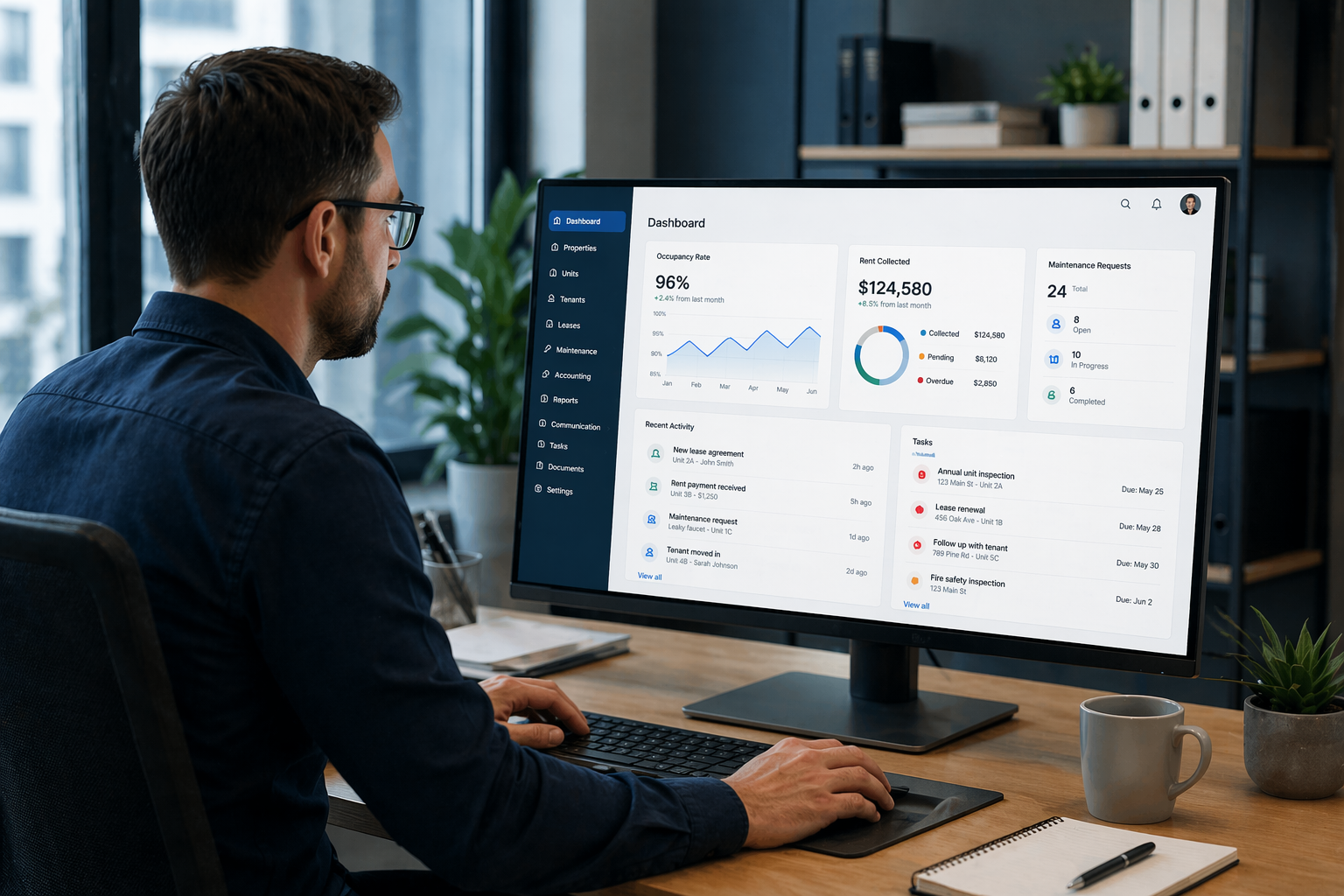
The demo went well. The pricing made sense. The implementation timeline looked manageable. Six months later, the platform is slow at three of your properties, integrations keep breaking, and your leasing team has worked around the system twice this quarter because it was faster than waiting for IT to fix it.
The software didn’t fail. The environment did.
This is the part of the platform decision that almost never comes up in a vendor sales call. Features, pricing, and demo experience get covered extensively. What each platform actually requires from your network, your endpoints, your security posture, and your IT infrastructure almost never does.
As a property management focused IT provider, we work inside Yardi, AppFolio, RealPage, Entrata, MRI, and Buildium environments every day. We work with property management companies across multifamily and commercial real estate. We know what these platforms look like from the operator side, from the IT side, and from the 11pm-on-rent-collection-day side.
In this post, we’ll walk through the top six cloud based property management systems that dominate multifamily and CRE. We’ll break down who each one is built for, what operators get wrong about them, and the IT reality behind each one that no vendor will tell you in a sales call.
The Six Best Cloud-Based Property Management Platforms for Multifamily and CRE
Each entry below covers who the platform is built for, what it does well, what operators should know going in, and what the IT environment needs to support it.
1. Yardi Voyager
Best for: Enterprise portfolios, 1,000+ units, complex compliance needs, institutional operators
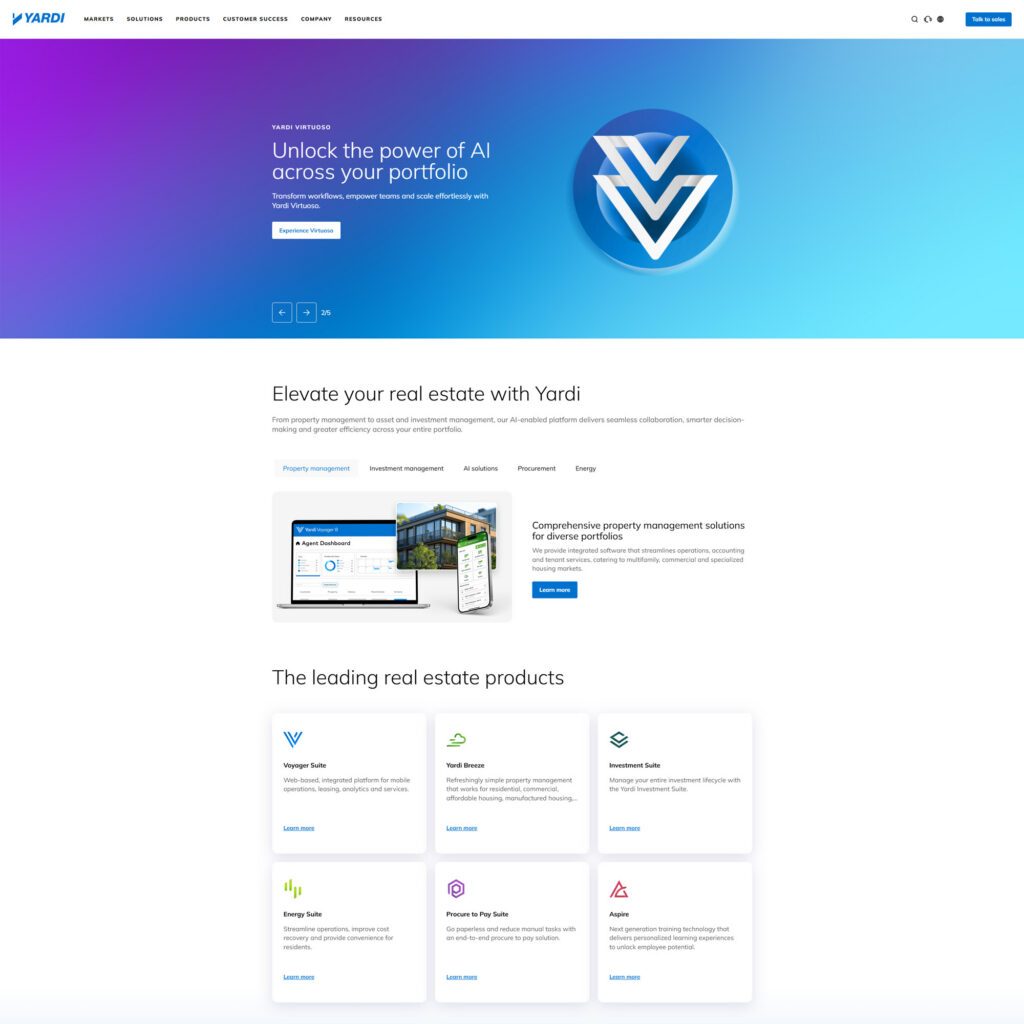
Yardi has been building property management software since 1984. Which is why the financial reporting is deeper, the compliance tooling for affordable housing and HUD programs is native to the platform, and the Yardi Marketplace integration ecosystem is broader than anything else on this list.
Voyager is the enterprise platform. The one large REITs, institutional operators, and government-regulated housing programs run. For operators managing 1,000+ units across multiple property types with complex accounting requirements, Voyager does things no other platform on this list does.
In 2025, Yardi launched Virtuoso, its AI platform. Agentic workflows for maintenance coordination, invoice processing, and financial reconciliation. Early deployments are showing month-end close times dropping from 20+ hours to under five.
Not cheap. Not plug-and-play. Implementation is a project. Configuration decisions made at setup determine how the system performs for years.
Pricing: Quote-based. Structured around square footage and module selection. Enterprise implementation budgets are significant.
IT reality: Yardi Voyager is one of the most infrastructure-intensive platforms on this list. Stable high-bandwidth connectivity across every property office is required. Update cycles can be disruptive without managed patching. Marketplace integrations introduce API and endpoint security exposure most operators underestimate. Voyager environments need dedicated IT oversight, not because the platform is unstable, but because its depth creates complexity that must be actively managed.
2. AppFolio Property Manager
Best for: Mid-to-large residential and mixed portfolios, 50-5,000+ units
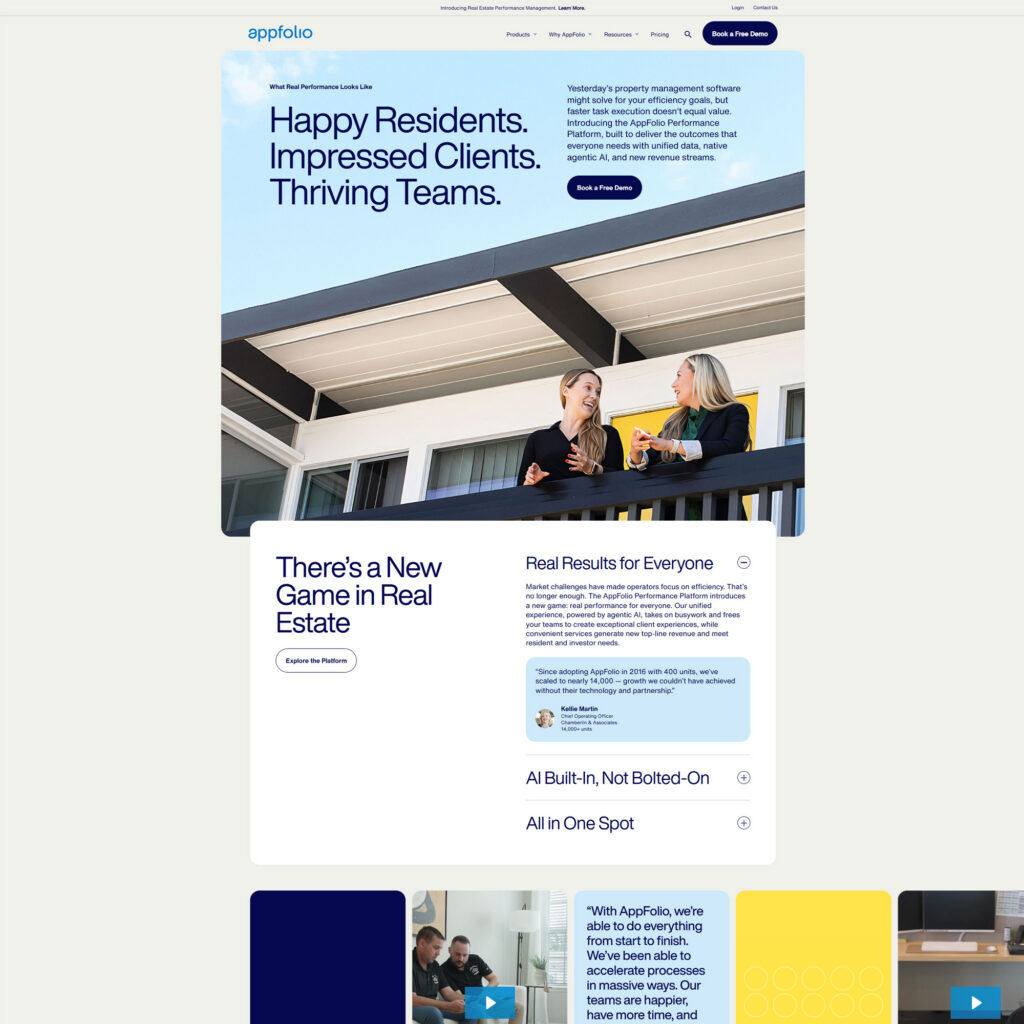
AppFolio is what most operators land on when they’ve outgrown Buildium and don’t want Yardi’s complexity. That’s not an accident. The interface is genuinely intuitive, the mobile experience is one of the strongest on the market, and AppFolio Stack makes connecting third-party tools relatively low-friction.
The Realm-X AI platform, introduced at the 2025 NAA Apartmentalize conference, is a real step forward. Agentic AI that can run entire leasing or maintenance workflows start to finish. For operators who have been sold AI features that mostly amount to better chatbots, Realm-X is different in practice.
For operators managing diverse portfolios including HOA, commercial, and residential under one system, AppFolio handles it. For operators with 50 units who want professional-grade tools without Yardi’s implementation weight, AppFolio is the right call.
Pricing: $1.49-$5.00 per unit per month. $298-$7,500 monthly minimum depending on tier. 50-unit minimum required.
IT reality: More IT-friendly than Yardi from a configuration standpoint, but consistent endpoint management and MFA enforcement across leasing and accounting staff are still required. Realm-X AI features increase data sensitivity. Tenant communication and financial data now flows through AI processing layers that need vetted access controls. Operators adding integrations through AppFolio Stack should run a vendor access review before connecting anything.
3. RealPage OneSite
Best for: Institutional operators, large multifamily portfolios prioritizing analytics and revenue management
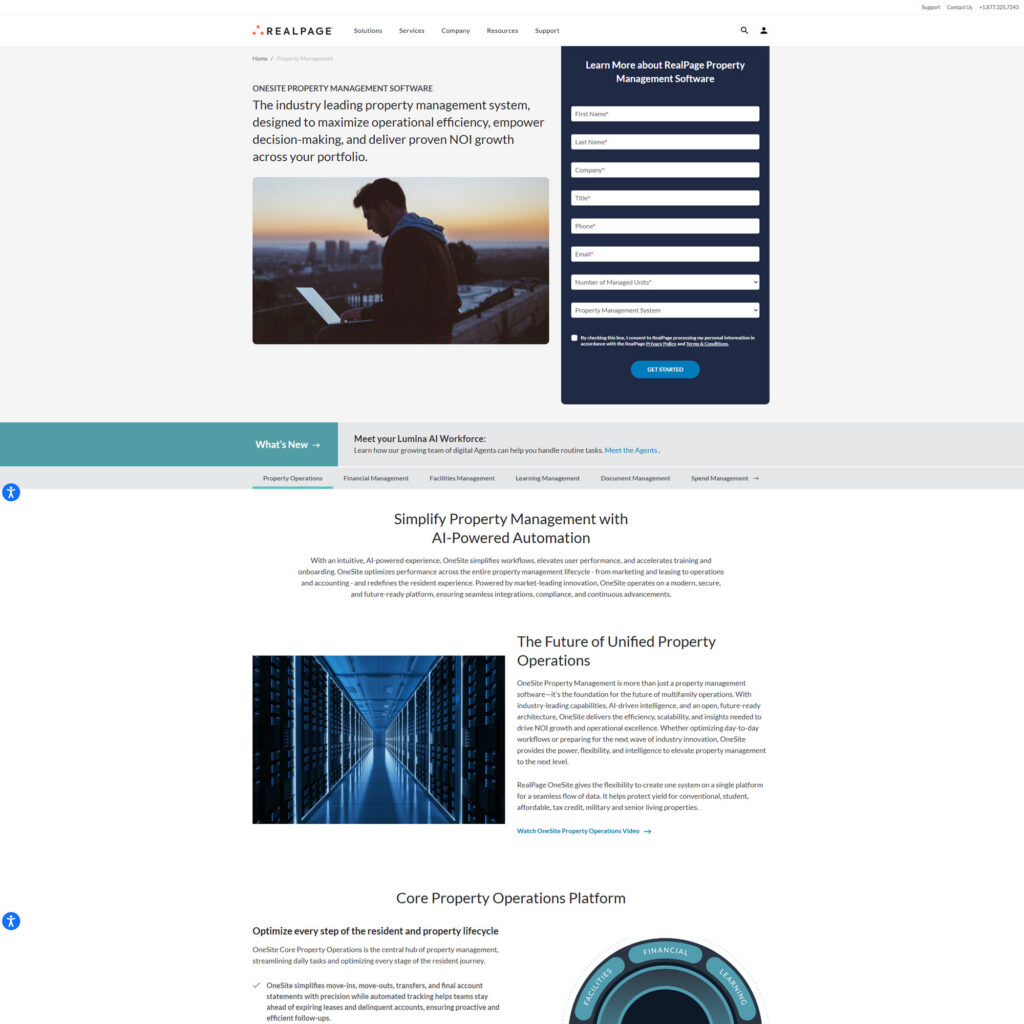
RealPage built its reputation on data intelligence. OneSite is the property management platform, but the real differentiator is the analytics layer sitting on top of it. AI revenue management, portfolio-level performance dashboards, and reporting depth that goes beyond what most other platforms offer.
Institutional operators managing large multifamily portfolios who need to see leasing performance, pricing data, and operational metrics across hundreds of units in one view will not find a comparable analytics layer elsewhere on this list.
RealPage holds more sensitive portfolio data than most platforms because of that depth. More data in one place means higher stakes if something goes wrong. That is why it’s critical to have adequate IT support within your business to protect and secure your PMS.
Pricing: Quote-based. Custom per portfolio.
IT reality: RealPage’s analytics depth means the platform accumulates financial and operational data at a volume that increases breach exposure. Data residency and access control policies need to be understood before onboarding. Third-party integrations, particularly for revenue management, require vendor access reviews that most PM teams never conduct. For institutional portfolios, the IT layer needs to match the platform’s enterprise grade.
4. Entrata
Best for: Large multifamily operators, student housing, affordable housing, operators wanting a single unified OS
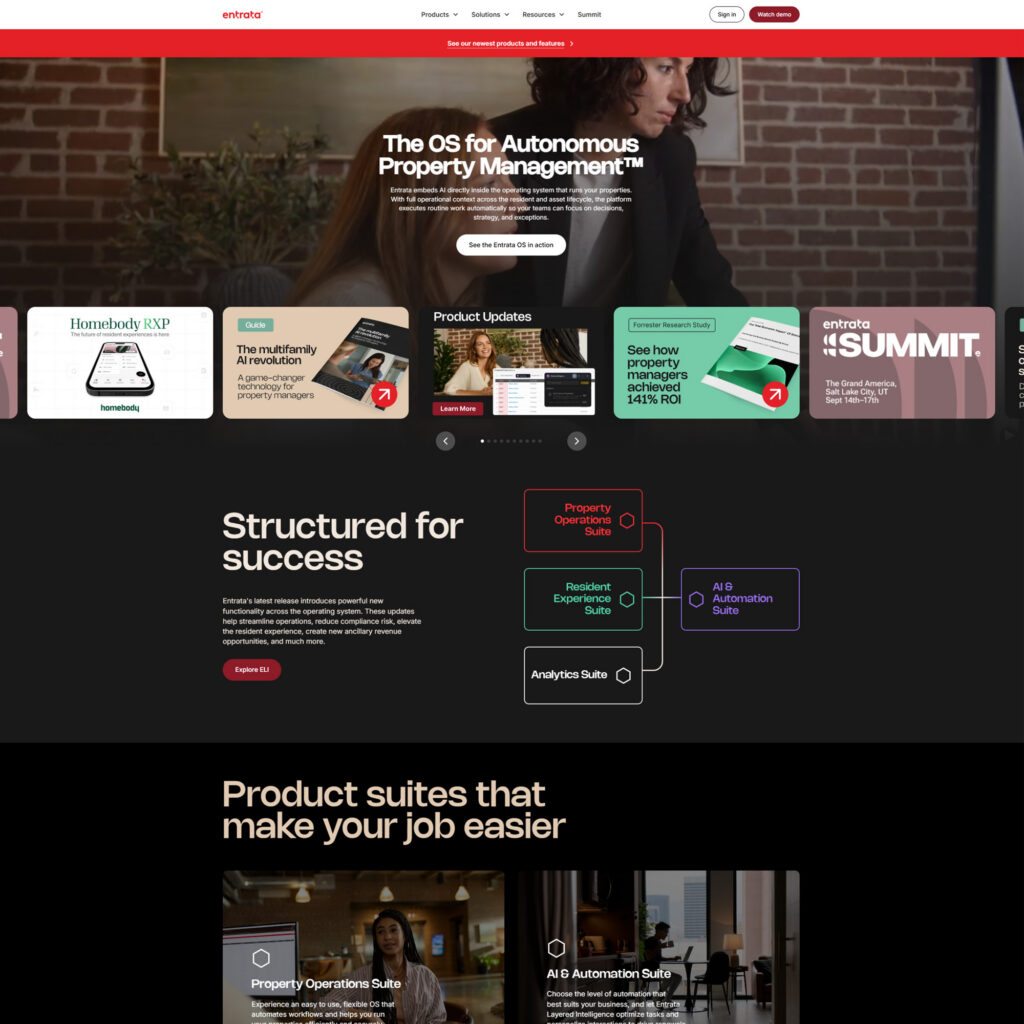
Entrata calls itself a property management operating system, not a software platform. That framing is accurate. Leasing, accounting, maintenance, payments, marketing, and resident experience all run under a single data model. Every interaction across the resident and asset lifecycle sits inside one system.
For operators who have spent years managing data fragmentation across multiple tools, Entrata’s unification is the pitch. And for most operators in that situation, it delivers.
The open API architecture is a genuine operational strength. Entrata’s AI operates at the transaction layer: not producing alerts, but advancing operational workflows automatically within defined guardrails. It is one of the more mature AI implementations on this list.
Pricing: Enterprise, quote-based.
IT reality: The open API architecture that makes Entrata operationally powerful is also a meaningful risk surface. Every integration connected through the API is a potential entry point. Operators running Entrata across multiple properties need network segmentation and vendor access controls in place before connecting third-party tools. The platform’s data unification means a security incident has a broader blast radius than on more siloed systems.
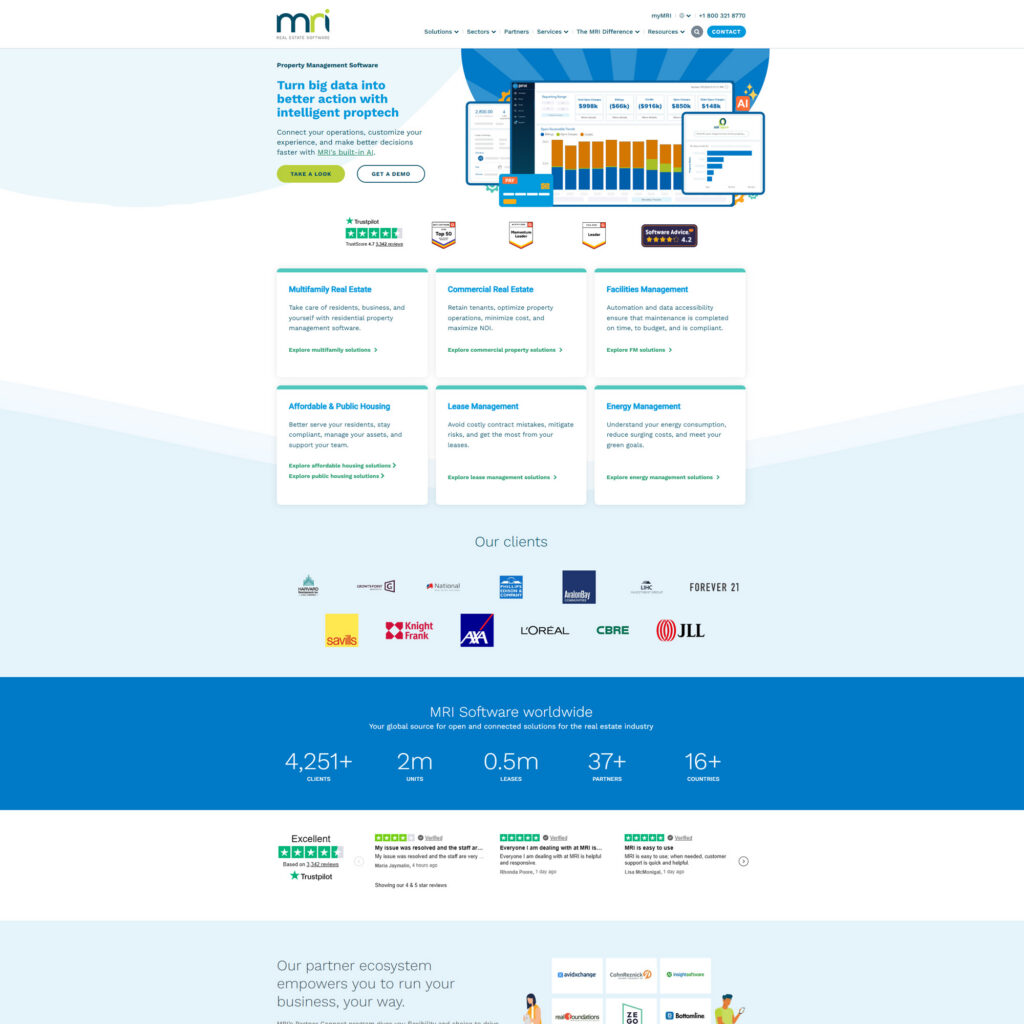
5. MRI Software
Best for: Mixed-use and commercial portfolios, complex lease structures, operators who need modular customization
MRI Software has been building real estate technology since 1971. The open and connected ecosystem, built around the MIX API and modular design, is what differentiates it. Operators managing complex lease structures, CAM reconciliation, and mixed-use portfolios that combine residential and commercial assets find depth in MRI that residential-first platforms don’t have.
If you’re running a primarily commercial or mixed-use portfolio and AppFolio or Buildium’s residential-first architecture creates constant workarounds, MRI is worth evaluating seriously.
In October 2025, MRI launched an enhanced version of its AI companion, Ask Agora, turning portfolio data into intelligent workflows and accelerating decisions across complex property operations.
Pricing: Quote-based.
IT reality: MRI’s modularity creates a complex dependency chain. Operators often run multiple integrated MRI components simultaneously. A failure in one module can cascade across financial reporting, maintenance, and leasing workflows. MRI environments benefit significantly from proactive monitoring and a managed IT layer that understands how the modules interact. The open architecture that makes MRI powerful also makes it more exposed without disciplined integration management.
6. Buildium
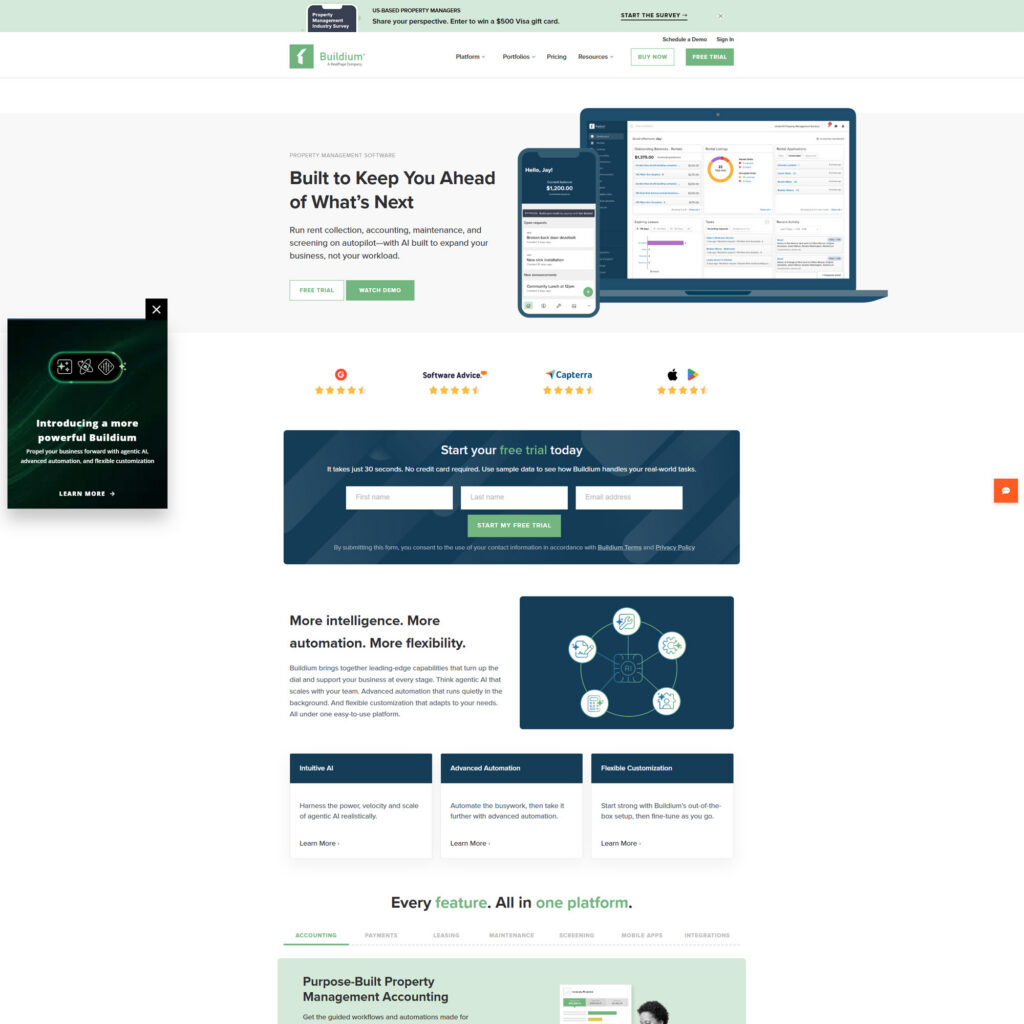
Best for: Operators managing under 500 units, residential and community association portfolios
Buildium is the most accessible platform on this list. Transparent pricing, clean onboarding, solid residential and HOA workflows. No minimum unit count. Operators who need professional-grade tools without enterprise-level implementation weight will find Buildium fits.
Buildium was acquired by RealPage, which brings additional development resources to the platform’s roadmap while preserving the SMB-friendly positioning that made it popular in the first place.
Worth noting: Buildium’s accessibility can create a false sense of security. Because the platform is easier to set up and lighter to run, operators on Buildium frequently underinvest in endpoint protection and access controls. The tenant PII and financial data inside a Buildium environment is just as sensitive as what’s inside a Yardi or RealPage environment. The platform is simpler. The exposure is not.
Pricing: $58-$375 per month. No unit minimum.
IT reality: The most IT-accessible platform on this list, but accessibility creates a false sense of security. Tenant PII and financial data are just as sensitive in a Buildium environment as in any other. The exposure is the same. The awareness often is not.
What Should You Actually Be Evaluating Before You Pick A Cloud Based Property Management Platform?
Most operators evaluate platforms on features, pricing, and demo experience. Those criteria tell you whether the software can do what you need it to do. They don’t tell you whether it will hold up inside your specific environment at scale.
Six things worth evaluating before committing to any platform:
- Portfolio fit: Does the platform serve your unit count, property types, and compliance requirements, or does it require workarounds at your scale?
- Security posture: What certifications does the vendor hold? SOC 2 Type II is the baseline. Data residency policies, breach response SLAs, and encryption standards matter too.
- Integration architecture: Is the API open or closed? What’s the security model for third-party connectors? Who bears responsibility when an integrated vendor is breached?
- IT infrastructure requirements: What does the platform actually need from your network, endpoints, and team to perform reliably? Ask the vendor directly. Then verify with someone who has run the platform in production.
- Total cost of ownership: Subscription pricing is one line item. Implementation, data migration, training, integration licensing, and ongoing IT overhead are the rest. Model 36 months before signing.
- MSP compatibility: Does the platform have a documented support path for managed IT providers? Is there an escalation channel that doesn’t route through a general support queue when something breaks on the 1st of the month?
Questions to ask any platform vendor before signing: What does your shared responsibility model actually cover? What’s your breach notification SLA? What documentation exists for IT providers managing deployments on your platform? Can you walk me through a real recovery scenario for a multi-site portfolio?
If the vendor cannot answer those clearly, you do not have enough information to sign.
How An MSP Supports Cloud Based Property Management Software Procurement
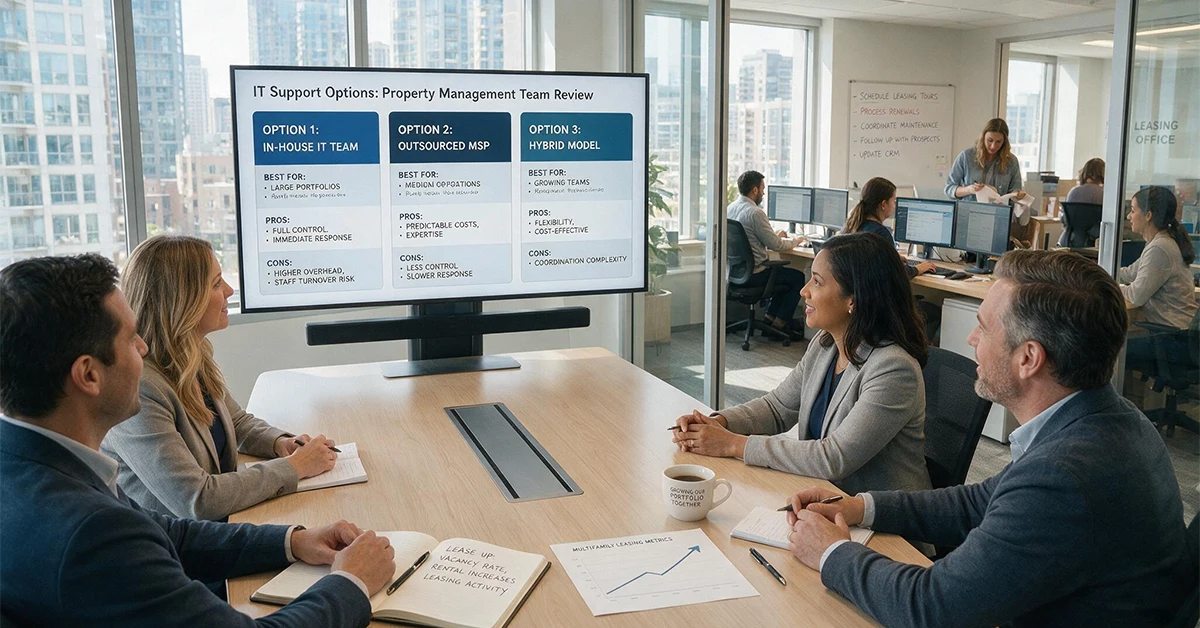
Evaluating and implementing a cloud PMS platform with dedicated IT support is a significant operational lift. Data migration, security configuration, integration setup, endpoint enrollment, access control design, and user training across multiple properties all have to happen before go-live.
Most property management teams don’t have anyone whose job is to manage that process.
What changes when an MSP with platform experience handles it:
- Infrastructure readiness is reviewed before the vendor demo begins, not after the contract is signed
- Security posture gaps are identified and addressed before the platform touches live tenant data
- Integrations are vetted for access control and vendor risk before they’re turned on
- Someone who has run these environments before is on call when something breaks
- That person picks up the phone on the 1st of the month
Three questions that separate a PM-fluent MSP from a generalist:
- Do they have hands-on experience with the specific platform you’re running or evaluating? Not familiarity. Hands-on.
- Can they walk through a real recovery scenario for a multi-site portfolio on that platform?
- Where does IT accountability sit during the go-live window and in the 90 days after?
If the MSP can’t answer all three without hesitating, they know cloud IT generally. They don’t know property management IT specifically.
The difference shows up when something goes wrong.
How Far Out Solutions Supports Property Management Companies Running Cloud Based Property Management Software
Far Out Solutions provides managed IT services to property management companies across multifamily, commercial, and mixed-use portfolios. Our team has direct, hands-on experience with Yardi, AppFolio, RealPage, Entrata, MRI, and Buildium environments. Not as observers. As the IT layer managing the infrastructure those platforms run on.
Companies like Cushman & Wakefield, BHOM, Lantower, and Watercrest Senior Living trust Far Out Solutions because our model is built around property management specifically. Not general IT with a property management add-on. Every account includes a vCIO: someone at the executive level who understands how platform decisions, IT infrastructure, and NOI connect.
Not a help desk rep. Someone who has been in the room when the platform went down and knew what to do.
What that looks like in practice:
- vCIO on every account: executive-level IT thinking applied to your platform and portfolio decisions
- Five-minute critical response time. When the platform fails during rent collection, we are already working on it.
- 99% client retention. Operators who have worked with us stay.
- Zero-trust security stack applied to every platform environment we manage
- Unified IT coverage across every property in the portfolio, not just the main office
We have managed Yardi Voyager implementations for institutional portfolios. Handled AppFolio transitions for operators moving from legacy systems. Built integration security frameworks that keep Entrata environments from becoming entry points. We know where these platforms break down.
More importantly, we know how to keep them from breaking down for our clients.
The Best Property Management Platform Is the One Your Environment Can Actually Support
Every platform on this list is capable. Yardi handles institutional-scale complexity. AppFolio balances power with usability. RealPage delivers analytics depth that enterprise operators rely on. Entrata unifies operations that were previously spread across multiple tools. MRI gives commercial operators the modularity their lease structures require. Buildium makes professional-grade property management software accessible without the enterprise implementation weight.
Choosing the right one comes down to three things: portfolio fit, operational requirements, and IT readiness.
The first two are well covered by every vendor’s sales team. The third one is almost never covered until something breaks.
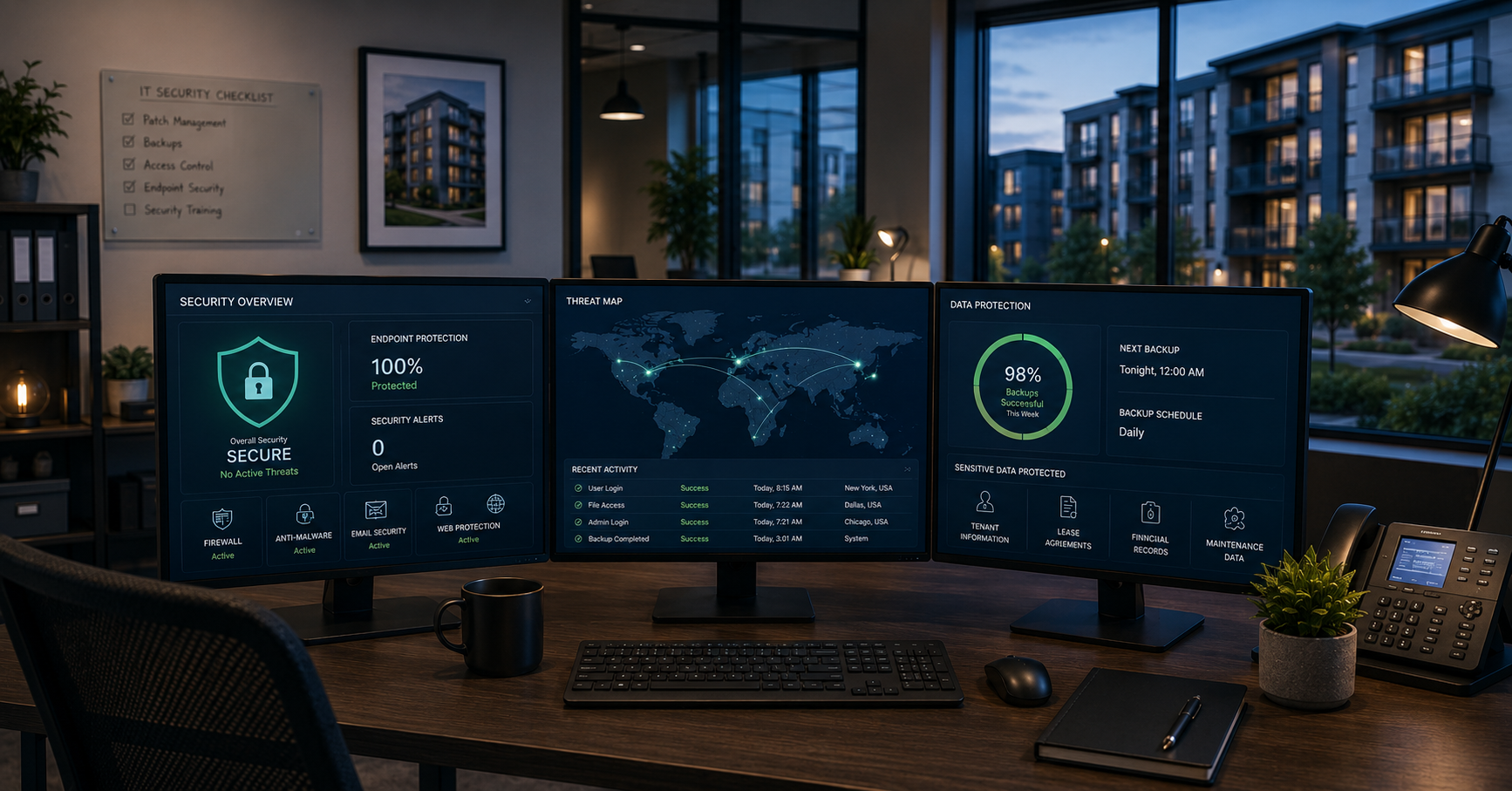
Cloud-based property management software is only as reliable as the infrastructure running it. The platforms don’t control your network, your endpoints, your access controls, or the security posture of your team. You do. Or your IT partner does on your behalf.
If you’re evaluating platforms or planning a transition and you haven’t run an IT readiness review, that’s where to start.
Far Out Solutions offers a 72-point IT assessment for property management companies evaluating or transitioning cloud PMS platforms. It covers network infrastructure, endpoint readiness, security posture, integration risk, and MSP compatibility. No commitment required. Start with the assessment. Make the platform decision with the full picture.