
What Decides Whether Your Automation Pays Off in 2026
The pressure to automate is coming from every direction right now. Your PMS vendor is pitching AI. Your competitors are talking about it at every conference. Your ownership group is asking why your NOI per headcount doesn’t look like the portfolio three blocks over. And somewhere in the last eighteen months, you probably bought something that promised to transform operations and became a line item nobody uses.
Sound familiar? We see it constantly. The tools aren’t bad. The trends driving them are real. The problem is almost never the software. It’s what has to be true underneath the software for any of it to work. Systems that can’t talk to each other. Data that’s fragmented across thirty apps. Integrations that were never built. Security that was never extended to cover the new workflows. The automation sits on top of all of that and amplifies whatever condition it finds.
This post covers the trends worth your attention in 2026 and, more importantly, what has to be true in your environment for any of them to actually pay off. The trends are legitimate. The foundation is what decides whether you get the ROI or the shelfware.
What AI Is Actually Doing in Leasing and Screening Right Now
AI leasing assistants have moved past the chatbot phase. The tools in use today handle real-time inquiry response across SMS, email, and web chat without a human in the loop, qualifying leads, answering property questions, and scheduling tours at 11pm on a Sunday the same way they do at 2pm on a Tuesday. The response-time gap that used to define leasing performance is closing fast.
A prospect who submits an inquiry at 9pm and gets a response Wednesday morning has already toured a competitor. Properties running AI leasing assistants are pushing response time under five minutes across every channel, around the clock. According to Buildium’s 2026 State of the Industry Report (more than 3,200 property management professionals, surveyed alongside NARPM) found AI adoption in PM jumped from 20% to 58% in a single year. Worth noting: only 8% of those companies have fully automated any workflow. Most are still using AI for drafting communications and property descriptions. The infrastructure to go further is the conversation this whole post is actually about.
The screening side is moving in parallel, and the stakes are higher. AppFolio’s 2025 Benchmark Report found that 70% of property managers reported an increase in fraudulent applications in the past year. Snappt analyzed nearly five million rental documents and found that 6.4% contained manipulated or fraudulent information. That’s one in sixteen applications. Traditional manual review catches a fraction of what AI screening does at scale, and the fraud is getting harder to spot, not easier. Generative AI has made fake pay stubs, bank statements, and tax returns indistinguishable from real ones to the human eye.
AI Leasing Tools Worth Knowing
- EliseAI handles inquiry response, lead qualification, and tour scheduling across SMS, email, voice, and web chat. Integrates with Yardi, RealPage, Entrata, and AppFolio. Strong on multifamily at scale.
- Funnel Leasing is built around a single guest card that consolidates all renter interactions across properties into one record. Native integrations with Yardi, RealPage, and Entrata. Designed for centralized leasing teams.
- AppFolio Realm-X embeds agentic AI directly into the AppFolio platform, covering leasing workflows, maintenance scheduling, and communications without switching systems. Best for operators already on AppFolio who want AI without adding another vendor.
- Entrata ELI+ is Entrata’s native AI leasing assistant. Handles lead response and tour scheduling within the Entrata stack. Worth evaluating if you’re already on Entrata and want to reduce integration complexity.
AI Screening Tools Worth Knowing
- Snappt specializes in document fraud detection, analyzing income documents for manipulation at the pixel level rather than just the data level. Catches AI-generated fakes that pass manual review. Integrates with most major screening workflows.
- TransUnion ResidentID adds identity verification and fraud signal detection on top of standard credit and background screening. Flags synthetic identities and document inconsistencies at intake.
- Yardi Resident Screening uses AI to score applicants against configurable criteria and flags risk patterns in application data. Native to the Yardi stack, which simplifies implementation for Yardi operators.
How Maintenance and Resident Operations Are Getting Automated
Maintenance has historically been one of the most labor-intensive workflows in property management: high volume, high variability, and a coordinator in the middle of every work order making calls about urgency, vendor assignment, and follow-up. Buildium’s 2026 report found that 38% of rental owners cite maintenance as their top source of stress, ahead of vacancies, managing residents, or collecting rent. That coordinator bottleneck is exactly where predictive maintenance platforms are cutting.
Modern maintenance automation handles intake, triage, and vendor routing without a human in the loop for the majority of standard requests. Work orders route automatically based on issue type, urgency, vendor availability, and pre-negotiated service agreements. The coordinator’s time shifts from scheduling to exception handling: the scenarios that actually need judgment. For operators running large portfolios, the per-door maintenance cost improvement from removing that coordination layer is real.

Resident self-service is maturing at the same time. Renewals, payment processing, maintenance requests, and routine communications can all route through resident portals that handle the transaction without a staff touchpoint. The resident gets a faster response. The staff member gets their time back.
The shift worth watching in 2026 is agentic tools. AI that doesn’t just draft a response or summarize a ticket, but takes action. Schedule the vendor. Update the work order record in the PMS. Send the resident the confirmation. Escalate when the criteria for escalation are met. The capability is here. Whether your stack is ready to carry it is a different question.
Maintenance Automation Tools Worth Knowing
- Lessen handles maintenance coordination end-to-end: intake, vendor dispatch, job tracking, and quality verification. Works across portfolios without requiring a specific PMS. Strong for operators who want to outsource the coordination layer entirely.
- Aptly functions as an AI operations layer that sits on top of your PMS. Handles maintenance intake, resident communications, and work order routing with bidirectional sync to Yardi, RealPage, Entrata, AppFolio, and others. Useful for operators who want automation without replacing their system of record.
- AppFolio Realm-X Maintenance routes and manages work orders within the AppFolio stack using AI-driven triage. Best for AppFolio operators who want maintenance automation without a separate integration.
- MRI Software includes maintenance workflow automation as part of its broader platform, with configurability suited for operators who need custom escalation paths or complex vendor management rules.
Resident Experience Tools Worth Knowing
- Second Nature pioneered the Resident Experience Platform category. Their Maestro product combines resident onboarding, benefits orchestration, and communication into a layer that sits alongside your PMS. The Resident Benefits Package (renters insurance, credit reporting, HVAC filters, and other bundled services) is the product most PM companies know them for.
- Entrata Resident Portal handles payments, maintenance requests, renewals, and communications natively within the Entrata stack. For operators on Entrata, it reduces the number of touchpoints where data moves between systems.
- Zuma (Kelsey) is an AI leasing and resident communication assistant that handles after-hours inquiries, collections reminders, and resident engagement through a hybrid AI-plus-human model. Integrates with major PMS platforms.
What Nobody Selling You Software Will Tell You
Every trend in the previous two sections assumes your systems can talk to each other. The AI leasing assistant assumes it can read availability from your PMS and write tour appointments back into it. The screening platform assumes it can access applicant records and push decisions to your workflow. The maintenance routing tool assumes it can pull vendor rosters, issue type taxonomies, and unit records from wherever you store them.
When those assumptions hold, the automation works. When they don’t, you get a capable tool running in a silo, producing outputs nobody acts on because they aren’t connected to the systems where work actually happens. The vendor who sold you the tool owns the capability. Nobody owns whether your environment can carry it. That gap is yours.
This is the thing nobody selling software will tell you, because their job is to sell the software. Automation layers on top of your stack. It doesn’t replace the stack, and it doesn’t fix what’s broken underneath. If your Yardi instance has fragmented data, the AI running on it will execute confidently on fragmented data. If your integrations between your CRM and your PMS are broken, the leasing assistant will produce leads that disappear into a gap nobody monitors. If your user permissions haven’t been updated since the last IT transition, the agentic tool will have access it shouldn’t and gaps in access it needs.
The plumbing has to work before the automation can do its job. Most operators find this out after go-live.
Why Automation Amplifies Your Data Whether It’s Clean or Not
Automated systems execute at scale and with confidence. They don’t slow down when the data looks wrong, they don’t ask for clarification, and they don’t flag the unit record that has three different addresses across three different systems. They process what they’re given and produce outputs at a volume and speed no human team matches. That’s the value proposition. It’s also the risk.
Fragmented records and duplicated data across your tech stack don’t become less of a problem when you add automation. They become more of one. The AI leasing assistant quoting the wrong availability is reading a unit record that hasn’t been updated since the last tenant moved out. The maintenance routing tool assigning the wrong vendor is working from a roster that’s out of date. The reporting dashboard showing the wrong occupancy rate is pulling from the system with the older data. Automation amplifies whatever condition it finds.
Data hygiene is the precondition, not something you clean up after go-live. Most implementations go the other direction. The tool gets purchased, the implementation starts, and the data problems surface during testing when it’s expensive and disruptive to fix them. The operators who get the most out of automation treat the data audit as part of the evaluation process, not a cleanup project after the contract is signed.
How Integration Actually Makes Automation Possible
The connective layer is what makes automation real. One action in one system triggering the right response across all of them. That’s the outcome operators are describing when they talk about automation working. A prospect submits an inquiry, the leasing assistant responds, qualifies the lead, books the tour, and writes the appointment back to Yardi. A resident submits a maintenance request, the platform triages it, routes it to the right vendor, updates the work order in AppFolio, and notifies the resident of the estimated window. One trigger. Multiple systems. No coordinator in the middle.
Getting there requires the integration layer to exist and function across your stack. For most operators, it’s partial. Some systems talk to each other, some don’t, and the connections that do exist weren’t built with automation workflows in mind. The leasing CRM might sync to the PMS on a 24-hour delay that made sense for reporting but breaks real-time automation. The maintenance platform might push work orders to the PMS but not pull vendor availability from the right source.
Disconnected tools make automation impossible regardless of how capable each individual one is. Yardi, AppFolio, RealPage, Entrata: every major PMS has integration frameworks and APIs. The question for any given operator is whether those integrations are built, configured correctly, and actively maintained. Integrations break. Vendor API updates change behavior. Permissions drift. Without someone owning the connective layer, the automation that worked at launch quietly degrades.
Automation as infrastructure means the connective layer gets designed first, not bolted on after the tools are purchased. That’s a different conversation than the one most vendors want to have.
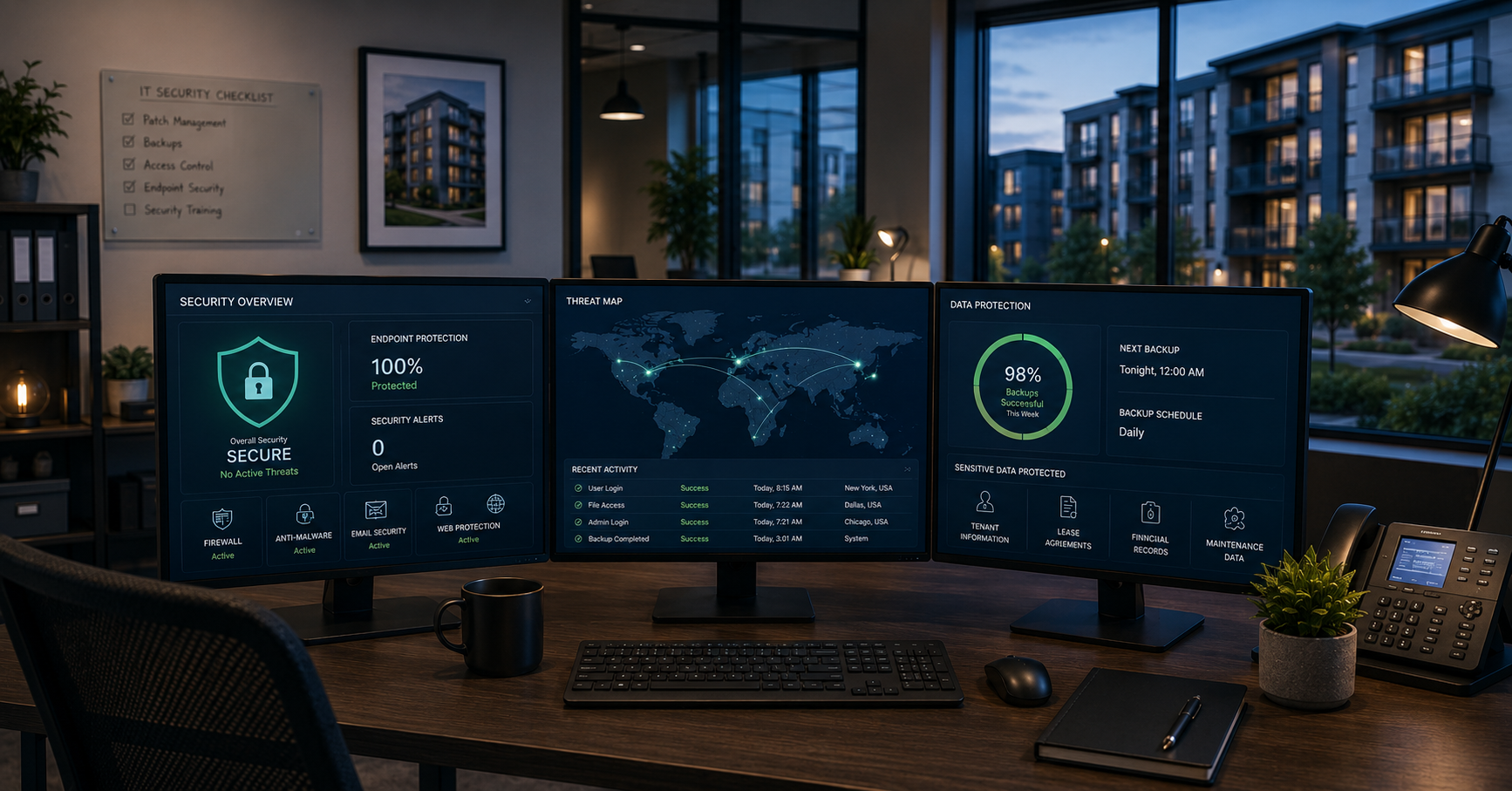
What Every New Automation Does to Your Security
Every integration is an access point. Every workflow automation is a new path through your data. Every API connection between your PMS and an external tool is a channel that can be exploited if it isn’t configured and monitored correctly. More automation means a larger attack surface, and the attack surface expands whether or not anyone on your team has mapped it.
Role-based permissions are where this gets operationally specific. The leasing assistant that reads unit availability should not be able to export resident financial records. The maintenance routing tool that touches work orders shouldn’t have access to the owner ledger. When automation workflows are built without explicit permission scoping, they tend to inherit broad access because that’s the path of least resistance during implementation. Broad access in an automated workflow is a different risk than broad access in a human workflow. It operates at scale, it’s harder to audit, and it doesn’t have the natural friction of a human who might notice something wrong.
Shadow AI compounds this. Employees adopting AI tools without IT review create ungoverned data flows that most operators don’t know exist. A leasing agent using a personal AI account to summarize applicant files has created a data channel outside your security perimeter. A property accountant using an AI tool to analyze owner statements has sent financial data to a system with no data agreement in place. Both are security exposures and compliance gaps, and neither shows up in your monitoring unless someone is looking.
Security has to be part of the automation conversation from the start, not a separate workstream addressed after the tools are live.
What Automation Actually Does to Your Team
The honest version of what automation does to staff: it handles volume, and people handle judgment. The AI leasing assistant handles the inquiry at 11pm. The leasing agent handles the prospect who needs a real conversation before they commit. The maintenance routing tool handles the standard request. The coordinator handles the tenant who’s called three times and needs someone to actually listen. That’s how it works when it’s working.
What gets in the way is rollout. Staff resistance to automation is predictable when the rollout doesn’t include them: when the tool is announced rather than introduced with input from the people using it, when training is a one-time onboarding session, when the tool gets it wrong in the first two weeks and nobody fixes it. The coordinator who ignores the routing platform because it keeps misrouting urgent requests isn’t obstructing progress. She’s responding rationally to a tool that doesn’t work for her workflow. That’s a rollout failure, not a software failure.
Adoption is the metric that tells you whether the investment paid off. A tool that’s in use drives the outcomes. A tool that’s installed and worked around drives the cost without the return. The operators who get the most from automation invest in change management with the same seriousness they invest in implementation. Role-specific training, clear communication about what the tool does and doesn’t do, a feedback loop that surfaces problems early. These are the difference between adoption and shelfware.
What All of This Actually Does to Your Numbers
When the foundation is right and the tools are adopted, automation shows up in the numbers in specific ways.
Leasing velocity improves when AI handles after-hours inquiries and no lead sits until the next business morning. AppFolio’s 2026 Benchmark Report found that AI-adopting firms project 31% portfolio growth in 2026, compared to 12% for non-adopters. The lease-up that took six weeks takes four. The vacancy days between tenants compress. At any meaningful portfolio size, that delta shows up in NOI.
Maintenance costs drop when predictive intake reduces emergency dispatches and repeat vendor calls. Routing the right vendor to the right issue on the first dispatch avoids the second call. Catching the HVAC issue before it becomes an emergency avoids the after-hours rate. Per-door maintenance cost improvement compounds across a portfolio.
Fraud caught at screening doesn’t become a collections problem or an eviction six months later. The write-off never happens. The legal cost never happens. The unit downtime during eviction proceedings never happens. AI screening at intake is a direct countermeasure to a problem that’s getting worse. The operators running document fraud detection at scale are absorbing materially less bad debt than the ones still relying on manual review.
The portfolio growth story is where this comes together. Automation lets you grow door count without proportional headcount growth. The coordinator managing 200 units manually manages 350 with automation handling the volume work. The leasing team covering one property covers three markets with AI handling first response. That’s the margin story, and it’s the one the best-run operators in 2026 are already telling their investors.
Who Actually Builds and Manages the Foundation This Runs On
Vendors sell the tool. They don’t own your stack, they don’t manage your integrations, and they don’t ensure the data flowing into their platform is clean enough to produce reliable outputs. Their implementation team gets you to go-live. What happens to the connective layer six months after go-live is not their problem. When an API update breaks the Yardi sync, when permissions drift after a staff change, when a new tool gets added without anyone updating the integration map: that’s yours. It’s yours.
Automation as infrastructure needs ongoing management. Integrations break. Permissions drift. Data degrades. New tools get added that weren’t planned for when the original architecture was designed. The attack surface grows with every connection. None of this is exceptional. It’s just how complex software environments work over time. The question is whether someone is watching it.
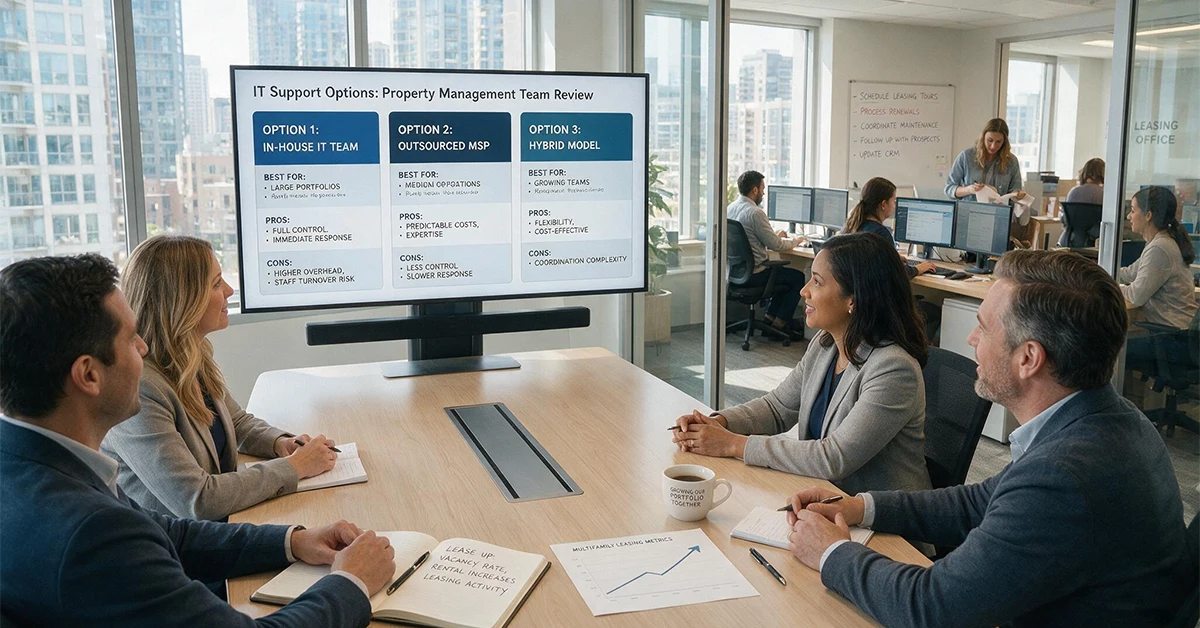
The right IT partner for a PM company running an automated stack is platform-neutral. No stake in which PMS you run or which automation tools you buy. Their job is to make the stack work together, whatever the stack is. vCIO-level thinking means the IT roadmap and the automation roadmap are the same conversation. When you’re evaluating a new leasing AI platform, your IT partner is in the room asking about the API framework, the data handling agreements, the permission model, and what happens to the integration when the vendor pushes an update. That’s the conversation that determines whether the tool works in your environment, not just in the demo.
Planning Your 2026 Automation Roadmap? Start With the Foundation.
The trends in this post are real. AI leasing and screening, predictive maintenance, resident self-service, agentic workflows: these are the tools shaping what competitive property management looks like in 2026. The operators getting the most from them aren’t the ones who bought the most tools. They’re the ones whose stacks were ready to carry them.
Far Out Solutions builds and manages the IT foundation that makes automation work across your portfolio. Platform-neutral. We work across Yardi, AppFolio, RealPage, Entrata, and the rest of the stack, whatever you’re running. We own the connective layer, the security posture, the data integrity, and the integration management that keeps automation functioning after go-live. That’s what a vCIO on every account actually means: your IT roadmap and your automation roadmap are one conversation, not two.
Before you buy the next tool, find out if what you have can carry it. We can start with a Property Technology Assessment: a clear read on your current stack, your integration gaps, and what needs to be true before the next investment pays off.